
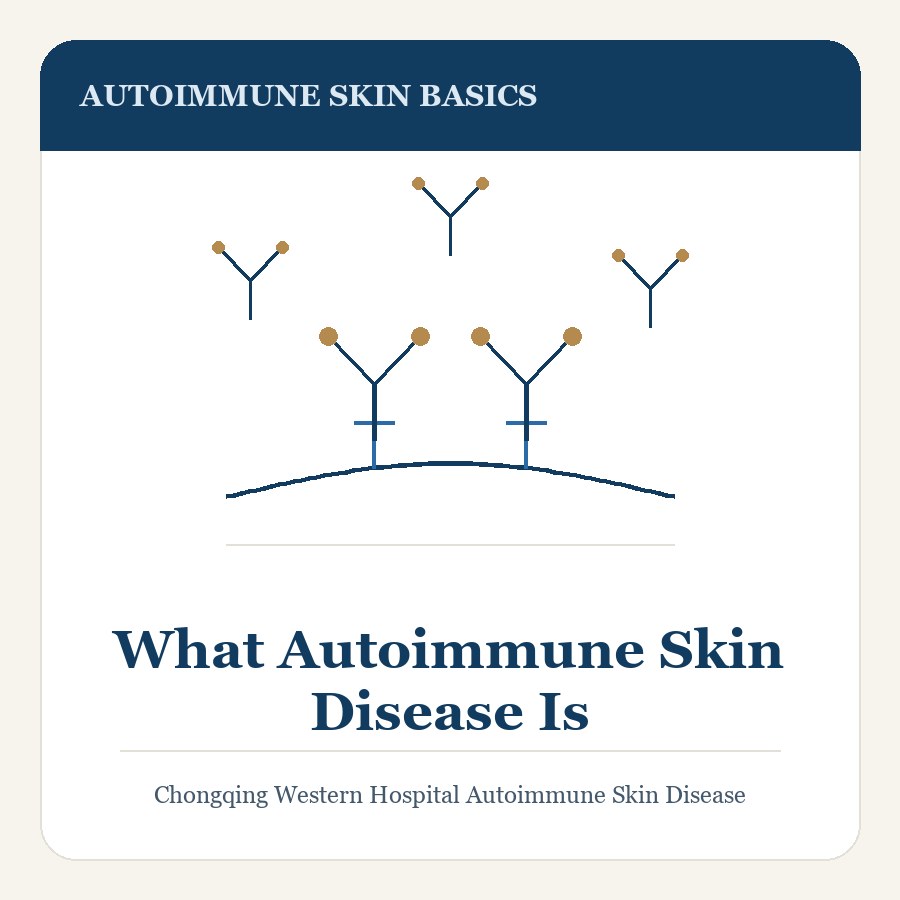
In short. How the immune system comes to attack the skin, the main categories these conditions fall into, and why they behave as long-term illnesses rather than passing rashes.
Key points
- A diagnosis of autoimmune skin disease usually means a long relationship with a dermatology team rather than a short course of treatment.
- The work is to control active disease, keep it controlled, watch for involvement of other organs, and reduce the burden it places on daily life.
- Improvement is realistic; a cure usually is not.
The immune system's job is to tell self from non-self. In autoimmune skin disease that discrimination fails, and immune cells or antibodies recognise part of the person's own skin as a target. What follows depends on which structure is mistaken for an enemy: the proteins that bind the epidermis to the layer beneath it, the collagen that gives skin its strength, the glands and follicles, or the small vessels that feed it. The rash, blister or hardening visible on the surface is a consequence of that attack, not the cause of it.
The main categories
Dermatologists group these conditions by the structure under attack. Blistering diseases, of which pemphigus and bullous pemphigoid are the best known, target the adhesion proteins that hold the skin together, so the skin separates and fluid collects. Connective tissue diseases, including cutaneous lupus erythematosus, morphea and systemic sclerosis, involve the collagen and the supporting matrix, and produce inflammation, pigment change and tightening. Lichen planus is an immune attack on the basal layer of the epidermis and on mucous membranes. Dermatomyositis combines characteristic skin signs with inflammation of muscle and small blood vessels.
The categories overlap, and their boundaries are less tidy in practice than in a textbook. One person may carry features of more than one, and a diagnosis can be revised as findings appear, which is one reason these conditions are followed over years.
What they have in common
Almost all of them are chronic. Treatment aims at suppressing the immune attack and controlling symptoms, not at removing the underlying tendency, so most people need long-term care and most experience flares. Many are sensitive to ultraviolet light, which means a flare can follow sun exposure. Many improve with treatment and then worsen when it is stopped too quickly.
Who is affected
These conditions are uncommon but not rare, and they affect people of every age, sex and background. Most have a genetic contribution that raises susceptibility without determining that disease will occur, and most are probably set off by that susceptibility combined with an environmental event. In most cases there is no single cause to identify. What can be offered is accurate diagnosis, prompt control of active disease, and monitoring that catches complications early.
What treatment can and cannot do
Modern treatment can control most of these conditions well enough for people to live ordinary lives, and sometimes it holds the disease quiet for long periods. It cannot guarantee that outcome or promise a permanent remission, and it often carries a real burden of monitoring and infection risk, which a clear plan names in advance.
What the diagnosis means
A diagnosis of autoimmune skin disease usually means a long relationship with a dermatology team rather than a short course of treatment. The work is to control active disease, keep it controlled, watch for involvement of other organs, and reduce the burden it places on daily life. Improvement is realistic; a cure usually is not.
Seek urgent medical care if
- Blisters or raw eroded skin are spreading quickly, or the mouth and throat are involved so that eating or drinking is hard.
- There is fever with a widespread rash, or the skin is suddenly painful and begins to peel.
- There is new breathlessness, chest pain, or a rapidly worsening general illness alongside the skin changes.
Frequently asked questions
What does it mean when a skin disease is called autoimmune?
It means the immune system, which normally tells self from non-self, has begun to recognise part of the person’s own skin as a target. What appears on the surface — a blister, a rash or hardening — is a consequence of that attack, not its cause.
Which structures in the skin do these conditions attack?
It depends on the disease. Blistering conditions target the adhesion proteins that hold the skin together. Connective tissue diseases involve the collagen and the supporting matrix. Lichen planus attacks the basal layer of the epidermis and the mucous membranes, and dermatomyositis affects small blood vessels in skin and muscle.
Can autoimmune skin disease be cured?
Usually not. Treatment suppresses the immune attack and controls symptoms rather than removing the underlying tendency, so most people need long-term care and most experience flares. Modern treatment can control these conditions well enough for people to live ordinary lives, but it cannot promise a permanent remission.
Risks & Limitations
- These are chronic conditions that are managed rather than cured, and flares are expected along the way.
- Immunosuppressive treatment raises the risk of infection and needs regular blood monitoring.
- Long-term systemic corticosteroids carry real side effects, including bone, metabolic and eye complications.
- Steroid-sparing agents and biologics have their own risks, including blood count, liver and kidney effects.
- Treatment is usually long term, and relapse is common when it is reduced or stopped.
- No treatment works for everyone, response cannot be predicted, and nothing here is guaranteed.
- Some scarring, pigment change and hair loss may be permanent even with good control.
When to Seek Care
- Widespread blistering, or raw eroded skin that is spreading — seek urgent care.
- Blistering or erosions in the mouth or throat that make eating or drinking difficult — seek urgent care.
- Fever with a rash, especially while on immunosuppressive treatment.
- Sudden severe skin pain or peeling of the skin — seek emergency care immediately.
- New breathlessness or chest pain, which may indicate involvement beyond the skin — seek emergency care.
References & Further Reading
- American Academy of Dermatology (AAD) — public and clinical guidance
- International Pemphigus & Pemphigoid Foundation — patient and clinical resources
- Cochrane Library — systematic reviews in dermatology
- Chinese Medical Association, Dermatology Branch — clinical guidance
This page is patient education, not medical advice, and it does not cite individual studies. Discuss your own case with a qualified clinician. To arrange an assessment at Chongqing West District Hospital, see Contact & Consultation.